

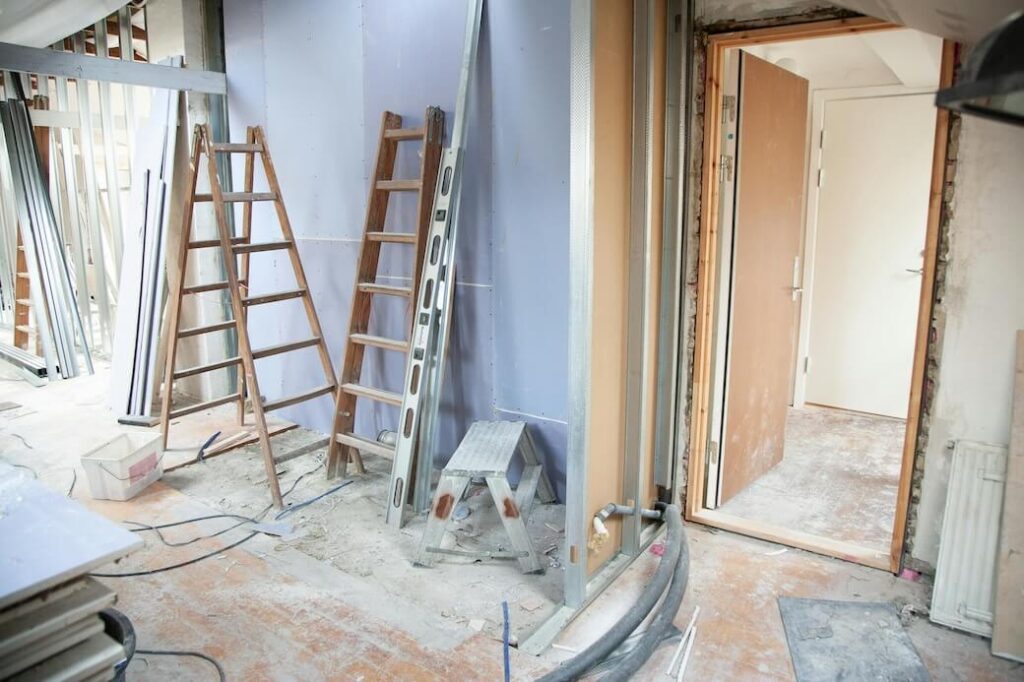
If your refurb has structural elements or extensions, involves a change of use, or needs planning permission or Building Regulations approval, it likely falls into the final category: heavy refurb. That changes things.
Heavy refurbishment works carry a different category of risk, and most bridging lenders either cannot or will not lend on it (even if they say they do).
Below: where a refurb crosses into heavy, how the financing is structured differently from light refurb lending, and what lenders need to see in the application.
What counts as heavy refurbishment?
There’s no universal definition. Lenders draw the line in different places.
As a rule of thumb, heavy refurb means works that involve one or more of the following:
Structural alteration.
Removing or adding load-bearing walls, underpinning, structural roof work. Anything that requires a structural engineer’s involvement and Building Regulations sign-off.
Extensions.
Rear extensions, side returns, loft conversions with structural elements, dormer windows that require planning permission.
Change of use.
Converting a commercial unit to residential, or reconfiguring a dwelling for a different use class. Planning permission is almost always required.
Major internal reconfiguration.
Full gut-and-reconfigure of a building’s internal layout, even where the external envelope remains unchanged.
HMO conversion.
Converting a standard house into a House in Multiple Occupation. Depending on the extent of the works and the local planning position, this can sit at the upper end of heavy or tip into development finance territory.
What isn’t heavy: cosmetic improvements, a new kitchen or bathroom, rewiring, replumbing without layout change, redecoration, new flooring, boiler replacement. Those are light or at most medium refurbishment whatever they cost, and are funded on different terms.
Related: Refurbishment Bridging Finance: Light, Medium and Heavy
How heavy refurbishment finance differs from light
A bridging lender lends on the value of the asset. With significant structural work you’re likely to decrease the property’s value (knock down walls, take off the roof, gut the interior) before you increase it. At least at the start, the build looks more like a ground-up development than a value-adding refurb.
A heavy refurb product has to reflect that extra risk, so it’s structured differently in several material ways.
| Light refurbishment | Heavy refurbishment | |
|---|---|---|
| Lending basis | Current value only | Current value + GDV (post-works value) |
| Drawdown structure | Single advance, or two tranches | Staged drawdowns tied to works milestones |
| Monitoring surveyor | Not required | Mandatory, visits at each draw stage |
| Valuation | Current market value only | Current value + GDV assessment |
| Documentation | Basic schedule of works, contractor quotes | Detailed schedule with quantities, architect plans, planning status, contractor CV, QS on larger schemes |
| Lender pool | Wide: most bridging lenders | Narrower: specialist lenders only |
| Rate (indicative) | From 0.65% per month | From 0.85% per month |
| Typical LTV | Up to 75% of current value | Up to 70% of current value or 65 to 70% LTGDV |
| Term | 3 to 12 months | 12 to 18 months |
Lending against current value and GDV
On a straightforward refurbishment bridge, lenders advance against the property’s current value. On a heavy refurbishment that often isn’t possible, for the reasons above, so you need a lender that will assess both current value and GDV (gross development value).
A property worth £300,000 as it stands that will be worth £550,000 after a structural conversion is a different borrowing position from one lent on current value alone.
The spread between LTV (loan to value) and GDV reflects the impact of the works, and a lender underwriting both gets a far more accurate picture of the risk and the upside.
Staged drawdowns
A light refurb bridge typically arrives as a single advance, or at most in two tranches. The project is clearly scoped and bounded (e.g. putting in a new kitchen). The risks and delays are predictable and easy to model.
Heavy refurbishment projects are bigger, with more unknowns and more risk. Lenders often (it depends on the project) release funds in staged drawdowns tied to works milestones, much as they would on a ground-up build.
That protects the lender but adds steps for the developer. Build it into your cashflow from day one.
Monitoring surveyor
A light refurbishment scheme has no monitoring surveyor because it doesn’t need one. The borrower manages the works, and the lender’s involvement ends at drawdown.
On heavy schemes, the lender will likely appoint an independent monitoring surveyor to visit the site at each drawdown stage, check that works have been completed to specification and on budget, and certify the next tranche before it releases.
Monitoring surveyor fees range from £1,500 to £4,000 per visit depending on scheme size. The borrower pays them, so budget for them. They also affect timelines, because funds aren’t released until the monitoring surveyor signs off.
The documentation package
A light refurbishment application needs a basic schedule of works and contractor quotes. A heavy refurbishment application needs a great deal more.
Lenders assessing a heavy scheme are underwriting both the cost of the works and the credibility of the GDV. They need enough detail to believe both.
8 things lenders need to see for a heavy refurbishment scheme
Detailed schedule of works.
A line-by-line breakdown of works with costs. A summary won’t do. The monitoring surveyor inspects against this document at each stage. ‘Full refurb, £80,000’ is not a schedule of works.
Contingency allocation.
Lenders want to see a contingency allowance stated in the schedule. No contingency reads as an undercooked appraisal. It also means any cost overrun has no buffer and immediately becomes a funding problem.
Architect plans or drawings.
Showing the existing state, the intended works, and the end configuration. For extensions and structural conversions, the lender’s valuer needs these to assess GDV credibly.
Planning permission.
If the works need planning, confirm the status at application stage. Lenders handle planning risk differently: some lend on the basis that planning is approved; a handful will lend on a pending application with conditions attached to the facility. Know which approach the lender takes before you submit.
Building Regulations.
Confirm whether Building Regs approval is required and where the application sits. Lenders want to know it won’t block the exit.
Contractor appointment and track record.
Who is doing the works, what they’ve delivered on comparable projects, and whether they’re under a formal contract. The monitoring surveyor will want to be comfortable with the contractor as well as the works programme. A contractor with no relevant track record on a structural conversion is a red flag at underwriting.
QS cost review.
On larger schemes, typically above £500,000 in build cost, lenders will require a Quantity Surveyor cost review. Below that it’s often not required, but on complex projects it strengthens the application materially.
Exit strategy.
Sale at post-works value with comparable evidence, or refinance onto a BTL or investment mortgage with indicative terms from a term lender. The exit is what the lender is ultimately underwriting. The stronger and more specific the exit evidence, the more comfortable the lender is with the completion risk.
Where heavy refurbishment ends and development finance begins
This boundary causes the most confusion. Crossing it changes the product, the lender pool and the cost.
The practical markers that push a project from heavy refurbishment into development finance territory:
Creation of new residential units. Converting a house into two flats, or a commercial building into multiple residential units, is development finance. You’re creating something that didn’t exist before.
Works cost approaching or exceeding 60% of GDV. When the works cost a large share of the end value, the economics look more like ground-up development than asset improvement.
The building is structurally unviable in its current state. Where the works amount to a near-complete rebuild of the structure, development finance is usually more appropriate.
| Project type | Likely product | Why |
|---|---|---|
| House extension or loft conversion | Heavy refurb bridging | Improves an existing single asset; no change of use or unit creation |
| HMO conversion (existing single house) | Heavy refurb bridging | Reconfiguration of one dwelling; planning may be required but no new units created |
| House converted into two flats | Development finance | Creates a new residential unit; GDV underwriting and IMS oversight required |
| Commercial to single residential | Heavy refurb bridging typically | Change of use but single exit unit; some lenders straddle the line here |
| Commercial to multiple residential flats | Development finance | Multi-unit creation; always development finance territory |
| Major structural rebuild of existing house | Depends on scope and costs | If works approach 60%+ of GDV in cost, most lenders treat as development |
If a project sits on the boundary, approach lenders with experience underwriting both products.
A lender with appetite only for heavy refurbishment bridging that finds mid-underwrite that the scheme is really development finance will pull back, and vice versa.
Refurb exit options
As with almost any development loan, you need a solid exit strategy with contingencies. Lenders, unsurprisingly, want to know they’ll get their money back. With a refurb there are four common exit strategies.
Sale. The simplest exit is selling the renovated property and repaying the loan in full on completion. Lenders will look at comparable sales evidence at application stage to assess a realistic GDV.
BTL refinance. For single residential units being retained, a buy-to-let mortgage at post-works value. The property needs to be lettable and meet standard BTL criteria.
HMO mortgage. For schemes converted and retained as HMOs. Specialist HMO lenders assess the loan on prospective rental yield. You’ll need comparable rental data, and the licensing position and BTL criteria have to be met.
Commercial investment mortgage. For commercial or mixed-use schemes being retained for investment income. Lenders assess this on DSCR.
Talk to Fundingwise about your refurbishment project
We work with specialist refurbishment and development lenders across the UK.
If you’re working on a heavy refurbishment scheme, talk to us before you approach lenders directly.
Book a free consultation or call us on 020 4571 6186

Got a scheme to fund?
Property finance, in your inbox
Property finance insights from the Fundingwise team.
We'll email you a link to confirm. See our privacy policy for how we use your details.