
There is plenty of lender capital. What lenders see too little of is deals that arrive properly structured, with credible assumptions, a competent team and a realistic exit. Those get funded. The rest, however strong the site, run into delays, re-trades and sometimes nothing at all.
Below: how development finance works, what lenders look at, and what you need to control before approaching the market.

What is Property Development Finance?
Development finance is short-term lending, typically 12 to 24 months, structured around construction projects. Unlike a standard mortgage, it releases funds in stages as the build progresses, and you pay interest only on what you’ve drawn.
These loans cover:
- Land acquisition (if you don’t already own the site)
- Build costs: materials, labour, professional fees
- Pre-construction and planning costs
- Rolled interest, repaid at exit
Staging ties lender exposure to verified construction progress, which is why an Independent Monitoring Surveyor is always part of the process. It also means your interest cost grows with drawdown instead of running in full from day one.
Related: Development Finance Market: 2026 Review & Predictions →
Why Development Finance is Harder to Secure Than Most Developers Expect
Lenders are underwriting the risk of a build that hasn’t happened yet
At the point of application, a lender is assessing something that doesn’t exist yet. That shapes how they underwrite. Creditworthiness is the start. The bigger question is whether this project, built by this team, in this location, has a credible path to completion and exit.
Track record drives leverage
Leverage available depends heavily on lender type and borrower track record. High street and government-backed lenders typically operate at 50 to 60% LTGDV.
Challenger and established alternative lenders extend to around 65%, with LTC generally between 80 and 90%.
Specialist lenders can reach 70% LTGDV in the right circumstances. First-time developers typically face a ceiling at the lower end of the challenger range and often need to satisfy additional requirements to reach even that:
- A fixed-price contract with a reputable contractor
- A qualified quantity surveyor managing costings
- An architect or project manager with demonstrable delivery on comparable schemes
Lenders use track record to calibrate risk across team, programme and exit.
Your professional team is underwritten alongside you
Lenders assess your QS, architect and contractor as well as you. If anyone on the team lacks experience on similar schemes, that is a risk flag, and it can affect leverage, pricing or whether the lender is interested at all.
It is a common blind spot. Developers spend a lot of time on their own case and little on how their team is presented.
Cost credibility is non-negotiable
Among other things, lenders require:
- Itemised build cost breakdowns from a qualified QS, not builder estimates
- A full build programme and cashflow projections
- Detailed Development Appraisal
- Contingency provision, typically 10%+ of build costs
- Professional indemnity insurance and collateral warranties from key appointments
- GDV assumptions supported by comparable evidence
A £200k gap between your GDV assumption and the lender’s independent valuation matters. At the leverage most developers target, it will likely make the deal unfundable at the LTV they need.
Exit strategy requires more than intent
Lenders want to know how the loan gets repaid, and “I’ll sell it when it’s built” won’t do. They’re assessing:
- Whether there is buyer demand for this asset type in this location
- What happens if the market softens before completion
- Whether refinance onto a term product is viable if sales take longer than expected
Multi-unit schemes often use a phased exit: early unit sales fund the final construction stages, and profit comes on the last sale. That has to be structured up front. It can’t be retrofitted once the build is underway.
“A good broker like Fundingwise will help you prepare everything you need long before it becomes a problem, so you have the best chance of securing funding on time and at sensible cost.”
What Do Lenders Assess?
Lenders assess applications on several criteria, including:
Loan-to-GDV vs. Loan-to-Cost
Loan-to-Gross Development Value (LTGDV): What you can borrow as a percentage of the completed property’s value.
Loan-to-Cost (LTC): What you can borrow as a percentage of total project costs.
Example:
- Total project cost: £1.5m (land £500k, build £900k, fees £100k)
- Completed GDV: £2.2m
- 70% LTGDV: You can borrow up to £1.54m
- 80% LTC: You can borrow up to £1.2m
| Metric | Value |
|---|---|
| Total project cost | £1.5m (land £500k, build £900k, fees £100k) |
| Completed GDV | £2.2m |
| 70% LTGDV | Up to £1.54m |
| 80% LTC | Up to £1.2m |
The lender uses whichever is lower. In this case, 80% LTC caps the facility at £1.2m, so £300k equity plus contingency is required.
Most developers focus on LTGDV. Many lenders cap on LTC. Know where you sit against both before you put a loan request to the market.
Independent Monitoring Surveyor (IMS)
Every development facility includes an IMS, appointed by the lender. Their role is to inspect the site at agreed construction milestones and confirm that completed work justifies the next drawdown.
Where this creates friction:
- Inspections not scheduled with sufficient notice, delaying drawdown
- Work not progressed to the stage claimed, holding up the next tranche
- Variations or cost overruns emerging mid-build without prior discussion
IMS fees are paid by the borrower: typically £3,000 to £8,000 up front for the report, then c.£1,200 + VAT per month for the build programme, depending on project scale. Budget for them as a project cost from the start.
Planning Permission Requirements
Full planning consent is the standard expectation, and development finance is not available on outline planning alone: until full consent is granted there is no costed scheme to build against. A land bridge can fund the site against its current value in the meantime, typically 50 to 60% LTV, and is refinanced onto development finance once full permission is granted.
No planning permission means no development finance. Bridging finance can fund acquisition while consent is pursued, and the development facility follows planning.
Related: The Development Finance Process: From Application to Drawdown
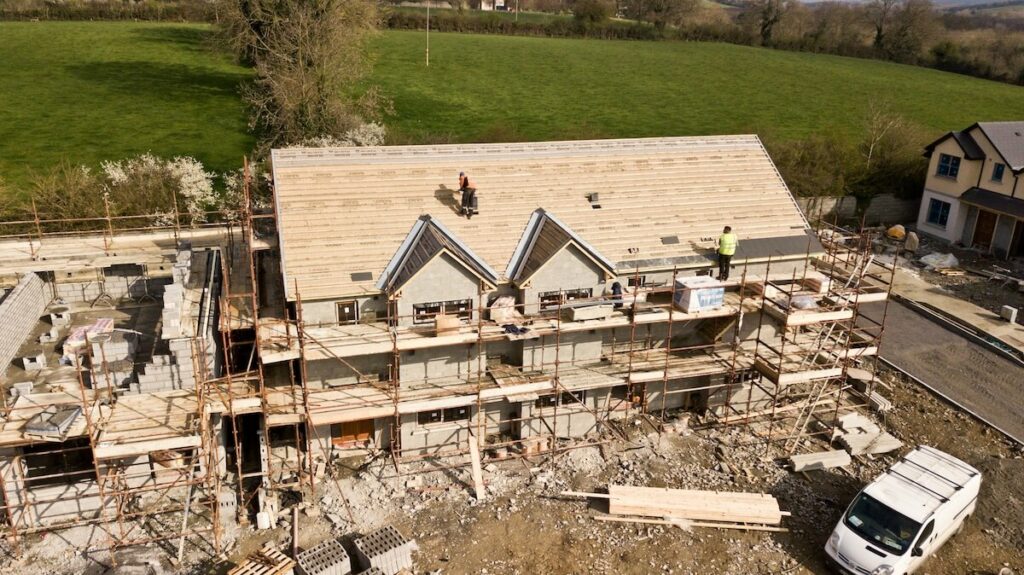
Case Study: £3.6M Development Finance for Kent Luxury Housing
The Challenge
Our client needed to acquire a detached house in Kent with planning permission to convert it into three luxury homes, each offering approximately 2,400 square feet. The GDV was £3.6m, but the project had a critical timing issue.
The vendor was retiring and using sale proceeds to purchase a smallholding. The smallholding’s owner had multiple interested buyers and imposed a firm five-week completion deadline. Miss that window, and the entire chain collapsed.
The Complexity
Standard development finance takes 6-8 weeks minimum. The client had five.
We needed to:
- Coordinate valuations, legal work, and due diligence simultaneously
- Identify a lender willing to move at speed without compromising on terms
- Structure £2.5m in funding (£2.3m senior debt at 9.75%, £200k mezzanine at 18%) to achieve 70% LTGDV
The Solution
We used existing lender relationships to secure priority processing. By managing all parties (solicitors, surveyors, the client, and the lender) we completed in under five weeks.
Result: Funding secured on time, chain preserved, project commenced without delays.
Key lesson: Speed only helps if the structure is right. A rushed deal with the wrong lender would have caused problems six months into the build. We needed both.
How Staged Drawdown Works
Development finance is released in tranches tied to construction milestones.
Typical drawdown schedule for a residential new-build:
| Stage | % of Loan |
|---|---|
| Land purchase + initial costs | 30 to 40% |
| Foundations complete | 15 to 20% |
| Superstructure complete (walls, roof) | 20 to 25% |
| First fix (electrics, plumbing, plastering) | 15 to 20% |
| Practical completion | Remaining balance |
Each release requires Independent Monitoring Surveyor (IMS) verification. If your builder runs ahead of schedule, you can request early drawdowns. If works lag, you won’t receive the next tranche until the IMS confirms progress.
Interest only accrues on what you’ve drawn. If you’ve received £600k of a £1.2m facility, you’re paying interest on the £600k you’ve drawn.
That is why development finance suits construction: no interest on money sitting unused.
Exit Routes
Most development loans roll up interest: each month’s interest is added to the loan balance and repaid at exit. That protects cashflow during the build, and it makes a properly planned exit essential.
Sale of completed property
The most straightforward route. Sale proceeds repay the loan, rolled interest, and fees. Profit is the residual. Multi-unit schemes often structure early unit sales to fund final construction stages, with profit realised on the last sale.
Refinance to a term mortgage
If building to hold (a BTL portfolio or longer-term commercial asset), you refinance onto a standard mortgage or term product at practical completion. Lenders want to see this plan up front. If the GDV doesn’t support refinance at the LTV required, you may be forced into a sale in conditions you haven’t planned for.
Development exit finance
If the build runs over programme or sales are slower than anticipated, you need exit finance, a bridging loan that repays the development facility while sales or refinancing complete. It is expensive. Avoid it with realistic timelines and real contingency in the original structure.
What You Need to Apply
An incomplete application delays approval. It also tells the lender the deal isn’t ready, and that colours everything that follows.
Core documentation required:
- Full planning consent
- Detailed build cost breakdown from a qualified QS
- Professional team CVs: architect, QS, builder, project manager
- Development track record: previous projects, completions, financial outcomes
- Site valuation (current value with planning)
- GDV valuation (independently supported)
- Proof of equity: bank statements or evidence of available capital
- Fixed-price build contract (typically required for first-time developers)
- Development appraisal demonstrating project viability
How the pack is structured, what it anticipates and how it presents the borrower and the scheme all bear on lender confidence, and so on terms.
The Full Cost of Development Finance
You need the full cost structure, beyond the headline rate, to know whether a deal works before approaching lenders.
Typical Fee Structure
| Cost | Range |
|---|---|
| Interest rate | 7.5% to 11%+ per annum (varies by lender tier, leverage, and risk profile) |
| Arrangement fee | 1.5% to 2% of loan |
| IMS fees | £3,000 to £8,000+ |
| Valuation fees | £1,500 to £5,000 |
| Legal fees | £2,000 to £5,000 |
| Exit fee | 1% of loan (lender-dependent) |
Worked example: £1.2m facility over 18 months.
| Cost | Amount |
|---|---|
| Interest (c.12% pa / mid-range challenger rate, rolled) | c.£216,000 |
| Arrangement fee (2%) | £24,000 |
| IMS, valuation, legal | c.£10,000 |
| Total finance cost | c.£250,000 |
On a project with £2.2m GDV and £1.5m in costs, gross profit is £700k. After finance costs, £450k, a 30% return on the £1.5m cost. That works, as long as the numbers going in are accurate and the build stays on programme.
Finance cost eats directly into margin, so structure matters more than rate. A lower rate on a poorly structured deal costs more than a higher rate on one that completes cleanly and on time.
How We Work
Preparation comes before any lender approach. Our process is built around that.
1
Initial consultation
We understand your objectives, track record, and the specifics of the project before any funding strategy is discussed.
2
Funding strategy & lender selection
We shortlist lenders on deliverability, structure and fit with your priorities.
3
Lender preparation & due diligence
We prepare lender-ready information and talk directly to senior underwriters, so the lender is clear on both borrower and project before the process moves on.
4
Valuation, monitoring & legal coordination
We manage valuation expectations, the IMS and legal coordination through the stage where most transactions hit friction.
5
Completion
We coordinate all parties (lenders, valuers, solicitors and any existing funders) through to a clean, timely completion.
6
Ongoing support & exit planning
We stay involved after drawdown, managing lender relationships and advising on refinances, extensions, exits and future project funding.
Next Steps: Getting Your Project Funded
If you’re planning a development in 2026, get the fundamentals right before approaching lenders:
- Commission a proper QS report, not builder estimates
- Assemble a professional team with relevant, demonstrable experience
- Work out your equity requirement, and don’t assume maximum leverage if the track record isn’t there
- Plan your exit before your funding strategy
Then talk to us.
We’ll assess your project, tell you what’s realistic, and introduce you to lenders who are funding deals like yours now.
Book a free consultation | Call us: 020 4571 6186
The developers who move quickly and complete cleanly are almost always the ones who did the work early.

Got a scheme to fund?
Property finance, in your inbox
Property finance insights from the Fundingwise team.
We'll email you a link to confirm. See our privacy policy for how we use your details.